Super Aggregation for Broadcasters: How Regional TV Platforms Can Stay Visible in the Streaming Era
- Broadcasting
For broadcasters in 2026, the real challenge is no longer simply competing with global streaming platforms. It’s staying visible.
Viewers move fluidly between apps, devices, and recommendations. Discovery is now algorithmic and fragmented. And in that environment, even strong content can quietly disappear from daily viewing habits, not because it lacks value, but because it’s harder to find.
That shift is forcing a rethink across the industry. OTT is no longer just an extension of linear TV or a catch-up layer. It’s becoming the main gateway through which audiences discover and experience content.
And once that happens, the role of broadcasters changes fundamentally.
The ones who will stay relevant aren’t necessarily those with the largest catalogs. They’re the ones who make their platform the place audiences return to without thinking about it. That’s where super aggregation starts to matter.
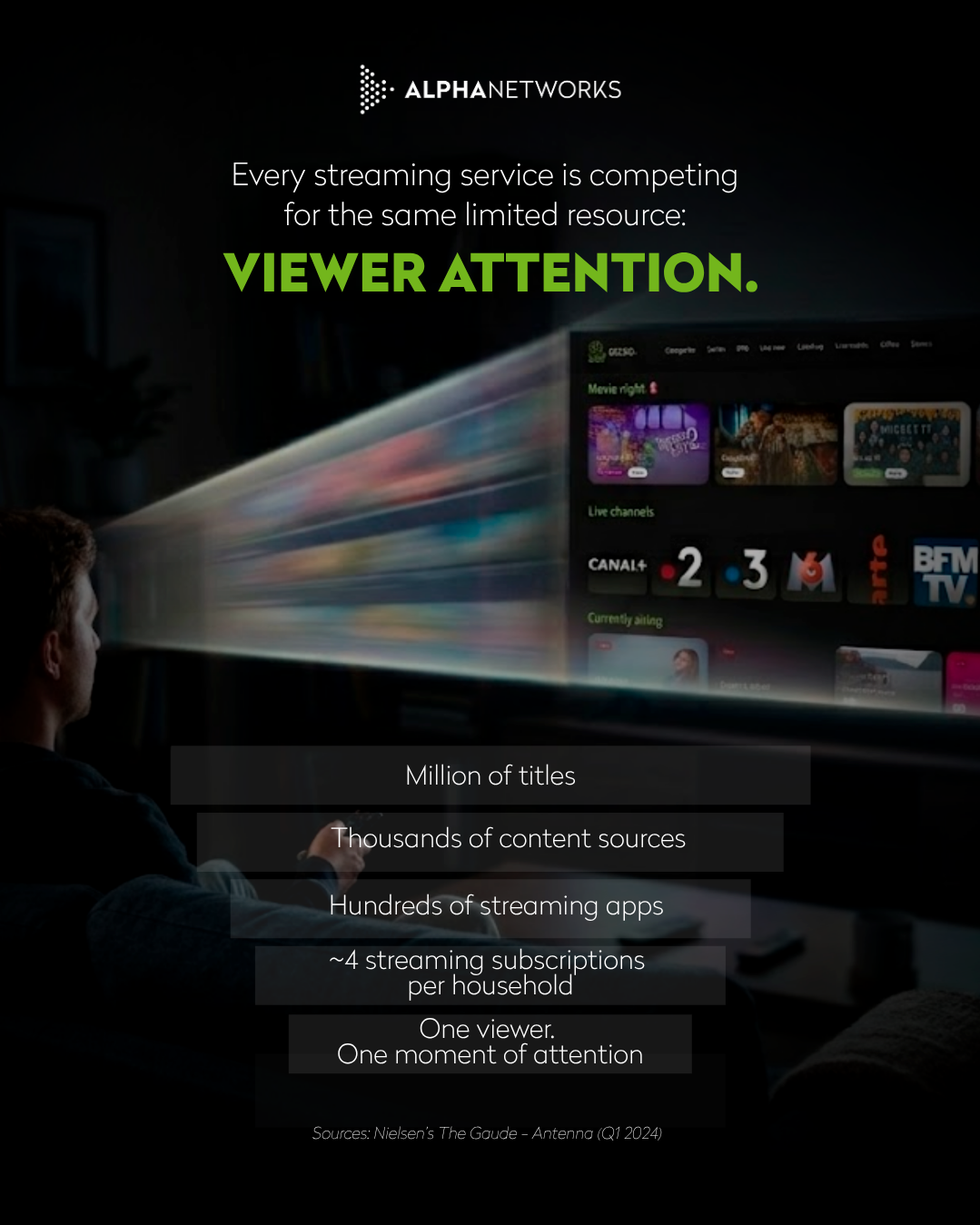
The shift toward streaming is no longer theoretical.
In May 2025, streaming reached 44.8% of total TV usage in the U.S., overtaking broadcast and cable combined for the first time. Between 2021 and 2026, streaming consumption grew by 71%, while broadcast and cable continued to decline. Europe is following a similar trajectory. In France, OTT video revenue is projected to reach $7.97 billion by 2029, with nearly 80% of the population already using OTT services. Yet linear TV still accounts for more than 65% of viewing time, showing that the future is not replacement, but coexistence.
This is where super aggregation becomes relevant. It’s not about choosing between linear and OTT. It’s about building a single environment where both can exist alongside partner services, niche content, and local programming.
For broadcasters, the question is shifting from “How do we extend our digital reach?” to “How do we become the first place audiences open?”
Audiences no longer think in terms of channels or apps. They expect a single place where everything is available: live TV, replay, sports, news, and sometimes even third-party platforms.
That expectation is what drives super aggregation. Instead of managing multiple disconnected experiences, broadcasters have the opportunity to bring everything together into one coherent environment:
- live linear channels
- catch-up TV
- local and regional sports
- news and public service content
- partner streaming services
The objective is not to imitate global streaming platforms, but to remain the default destination for local audiences and be the place they return to instinctively. Because once viewers leave the ecosystem to search elsewhere, re-engagement becomes increasingly difficult.
The number of global FAST channels grew by 14% since Q1 2025 and 73% since 2023, and hundreds of streaming platforms competing for attention. The result is paradoxical: more content than ever, but less visibility for any individual player.
Global platforms like Netflix have scale, but they lack local precision. They cannot fully reflect the cultural, linguistic, or regional nuances that define smaller markets. And they don’t hold the same deep institutional trust that regional broadcasters have built over decades.
That’s the real opportunity. Regional broadcasters already have audience trust, local rights and relevance, editorial proximity, and cultural understanding. Super aggregation is what allows them to turn that advantage into platform ownership.
A strong example is BBC iPlayer. In the UK, it has become more than a catch-up service. 22% of BBC TV viewing now happens via iPlayer, rising to 50% among younger audiences. Its growth outpaced major streaming competitors, not by replacing linear TV, but by integrating content into a unified digital experience.
That’s the model emerging globally: broadcasters becoming platforms, not just publishers.
The streaming ecosystem is expanding rapidly, but not in a structured way. There are now hundreds of platforms and 2,120 FAST channels globally. The more content exists, the harder it becomes for audiences to navigate it.
That fragmentation creates a clear opening for broadcasters. Instead of competing for attention inside someone else’s interface, they can become the interface itself.
A super aggregation strategy allows broadcasters to combine:
- owned content
- live programming
- regional rights
- partner services
- community and public content
into a single, unified experience.
Behind the scenes, aggregation is complex: Most broadcasters operate within environments shaped by legacy infrastructure, rights constraints, editorial workflows, and compliance requirements. Adding external content sources on top of that can easily create inconsistency, especially in search, navigation, and metadata.
And viewers don’t see the complexity. They only feel the friction. If a user searches for local football content, they don’t care where it comes from. They expect everything: live matches, highlights, archives, documentaries, to appear in one coherent view.
That’s why metadata has become central to super aggregation strategies. Broadcasters are increasingly investing in automation and AI-assisted enrichment to:
- reduce manual tagging efforts
- improve content discovery
- maintain consistency across catalogs
- scale editorial operations
Not to replace editorial teams, but to help them manage complexity without losing control.
Despite its appeal, super aggregation doesn’t require rebuilding everything from scratch. For most broadcasters, that would be unrealistic. They operate complex environments where linear workflows, compliance systems, and distribution chains are deeply embedded. That’s why modular approaches are becoming the preferred path forward. Instead of replacing systems, broadcasters can evolve them:
- integrating new services progressively
- maintaining existing workflows
- preserving governance and control
- expanding capabilities without operational risk
This allows super aggregation to happen step by step, rather than through disruptive transformation programs.
Even in a fragmented streaming landscape, broadcasters still hold a unique advantage: proximity. They understand their audiences, languages, and cultural context in a way global platforms cannot replicate. But that advantage only matters if audiences continue to engage within the broadcaster’s environment. Super aggregation is what protects that relationship. The broadcasters that remain central to viewing habits will not be those with the biggest catalogs. They will be the ones that make discovery effortless and content feel unified, regardless of source. Because in today’s environment, controlling access is as important as controlling content.
Super aggregation only becomes meaningful when it can be implemented without compromising operational stability. That’s where most strategies fall short.
At Alpha Networks, we’ve built a modular ecosystem designed specifically for broadcaster realities. Our ecosystem is designed specifically for the complexities of modern broadcasting:
- Tucano: The Aggregation Hub
Tucano is the central aggregation layer that brings together live TV, VOD, catch-up, and EPG data into one unified ecosystem. Provider-agnostic by design, it allows broadcasters to integrate multiple content sources while keeping full control over metadata, editorial logic, and content organization, making super aggregation simpler to manage operationally. - Gecko: The Video Platform & Experience
Layer
Gecko is the scalable OTT platform powering distribution, service management, and audience experience across aggregated ecosystems. Built for multi-tenancy and multi-publication, it enables broadcasters to manage multiple brands, regions, or services within a single platform while delivering a seamless, brand-centric viewing experience. With advanced discovery, editorial curation, and recommendation capabilities, Gecko helps audiences navigate fragmented content effortlessly, all within one consistent environment.
Together, these layers allow broadcasters to:
- integrate multiple content sources without disrupting existing workflows,
- maintain governance over metadata, rights, and distribution,
- expand services progressively instead of through high-risk migrations,
- deliver a unified viewing experience across fragmented ecosystems,
- and preserve operational control and brand identity throughout.
Super aggregation becomes not just a concept, but an operational reality.
Super aggregation is becoming a structural shift in how television ecosystems are built. But its success won’t be defined by ambition alone. It will depend on execution that respects how broadcasters actually operate today.
The question is no longer whether aggregation is part of the future. It’s whether broadcasters can implement it in a way that strengthens, rather than disrupts, what they’ve already built. And that’s where the real work begins.
If you’re exploring what a super aggregation strategy could look like for your video platform, contact Alpha Networks to discuss how a modular approach can help you evolve.
Explore key takeaways from NAB Show 2026, including AI-powered discovery, personalization, live streaming at scale, and monetizati...
Read publicationAlpha Networks showcased innovative AI-driven technologies at CES 2025, offering a fresh perspective on transforming content disco...
Read publicationAlpha Networks and Ateme have collaborated to deliver a secure, end-to-end video platform supporting the digital distribution of l...
Read publicationPrepare to share your content with top-notch products.
Take control of your content and share it with the world. Be part of the TV revolution today.
Talk to an expert